What causes an AC capacitor to fail?
Heat exposure over long cooling seasons is the main cause. Voltage surges, aging, and motors drawing excess current because of worn bearings or a dirty coil all contribute.

The run capacitor stores and releases the electrical energy that gets the compressor and condenser fan motor turning and keeps them running efficiently. It is a wear item, and sustained high ambient temperatures shorten its life — which is why capacitor failures cluster in the hottest part of the Florida cooling season.
Capacitor symptoms are distinctive enough that many homeowners suspect the part before a technician arrives. Confirming it still requires measurement, because a capacitor that has drifted out of tolerance can look perfectly normal.
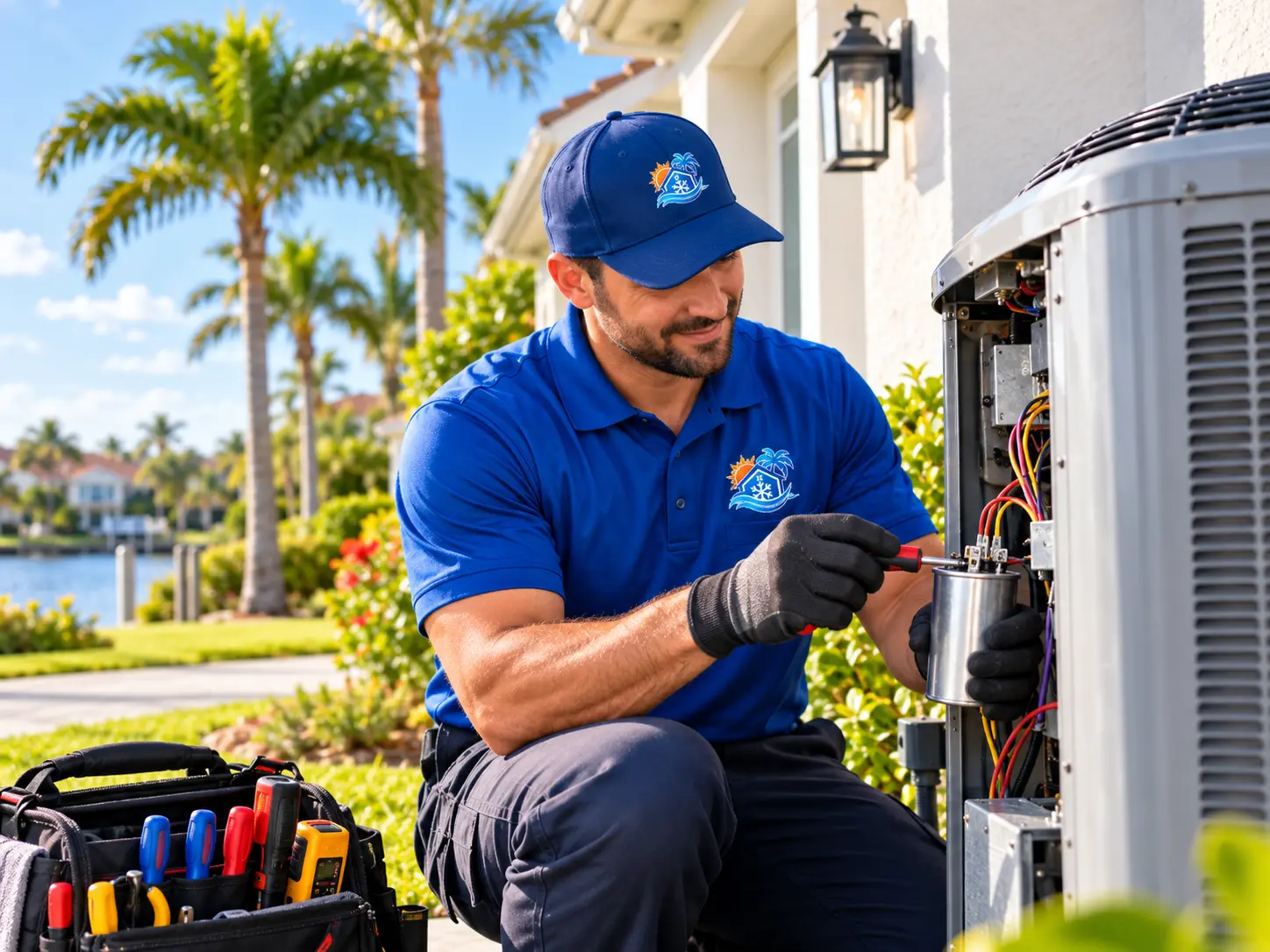
Heat is the dominant factor. A capacitor mounted inside a metal cabinet sitting in full Florida sun operates well above ambient temperature for months at a time, and the internal dielectric degrades. Voltage fluctuations, lightning-related surges, and a motor that is drawing more current than it should because its bearings are worn all accelerate the process.
Capacitors also fail gradually. Measured capacitance drifts below the rated value long before the part fails outright, and during that window the motor runs hotter and less efficiently. That is why a technician measures the value rather than only checking whether the motor spins.
This is a high-voltage component that stores a charge even after power is removed, which is why it is not a homeowner task. A technician disconnects power at the disconnect, discharges the capacitor properly, and measures capacitance in microfarads against the value printed on the case, usually replacing anything more than a few percent out of tolerance.
The rest of the circuit gets checked at the same time. A capacitor that failed early is often a symptom of something else — a contactor with pitted contacts, a fan motor drawing high amperage, or a condenser coil so dirty that head pressure is elevated. Replacing only the capacitor in that situation buys weeks, not years.
The replacement part must match the rated capacitance and voltage. Dual-run capacitors serve both compressor and fan and carry two ratings; single capacitors serve one motor. Using a higher voltage rating is acceptable, but the capacitance value must match the equipment specification.
Once replaced, the system is restarted and observed: fan rotation, compressor start behavior, running amperage, and system pressures. That confirms the capacitor was the whole problem rather than one visible part of a larger one.
For broader planning numbers, see the AC repair cost guide for Lakeland or try the repair cost calculator. Both give educational planning ranges rather than quotes.
Heat exposure over long cooling seasons is the main cause. Voltage surges, aging, and motors drawing excess current because of worn bearings or a dirty coil all contribute.
It is not recommended. Capacitors hold a stored electrical charge after power is disconnected and can cause serious injury. The part also has to be matched correctly to the equipment.
Service life varies widely with heat exposure and electrical conditions. In sustained Florida heat, capacitors generally do not last as long as they would in milder climates.
It will if the capacitor was the only failure. If the fan motor, contactor or compressor was already damaged, or if the real problem is airflow or refrigerant, more work is needed.
The outdoor fan pulls air across the condenser coil. Without it, head pressure climbs and the system protects itself by shutting down.
Read moreThe heart of the refrigeration circuit. Compressor problems deserve careful diagnosis before any major expense is authorized.
Read moreThe system runs but the house never reaches the set temperature. Start with the simple checks, then narrow down the mechanical causes.
Read morePreventive attention to filters, coils, drains and electrical components — the failures most worth avoiding.
Read moreDescribe what your air conditioner is doing and we can talk through the likely causes and current availability.
211 E Main St, STE #453, Lakeland, FL 33801