How do I know if my evaporator coil is dirty?
Gradually declining cooling, weak airflow with a clean filter, repeated coil freezing, and a musty smell when the blower starts are typical indicators. Visual inspection confirms it.

The evaporator coil sits inside the air handler and does the actual work of cooling and dehumidifying. Warm indoor air passes across it, refrigerant inside absorbs the heat, and moisture condenses on the fins and drains away. Because the coil is permanently wet during the cooling season and handles every cubic foot of air in the house, it accumulates problems over time.
Coil issues fall into three groups: fouling that blocks airflow and insulates the surface, corrosion leaks that release refrigerant, and drainage problems caused by dirt on the coil face.
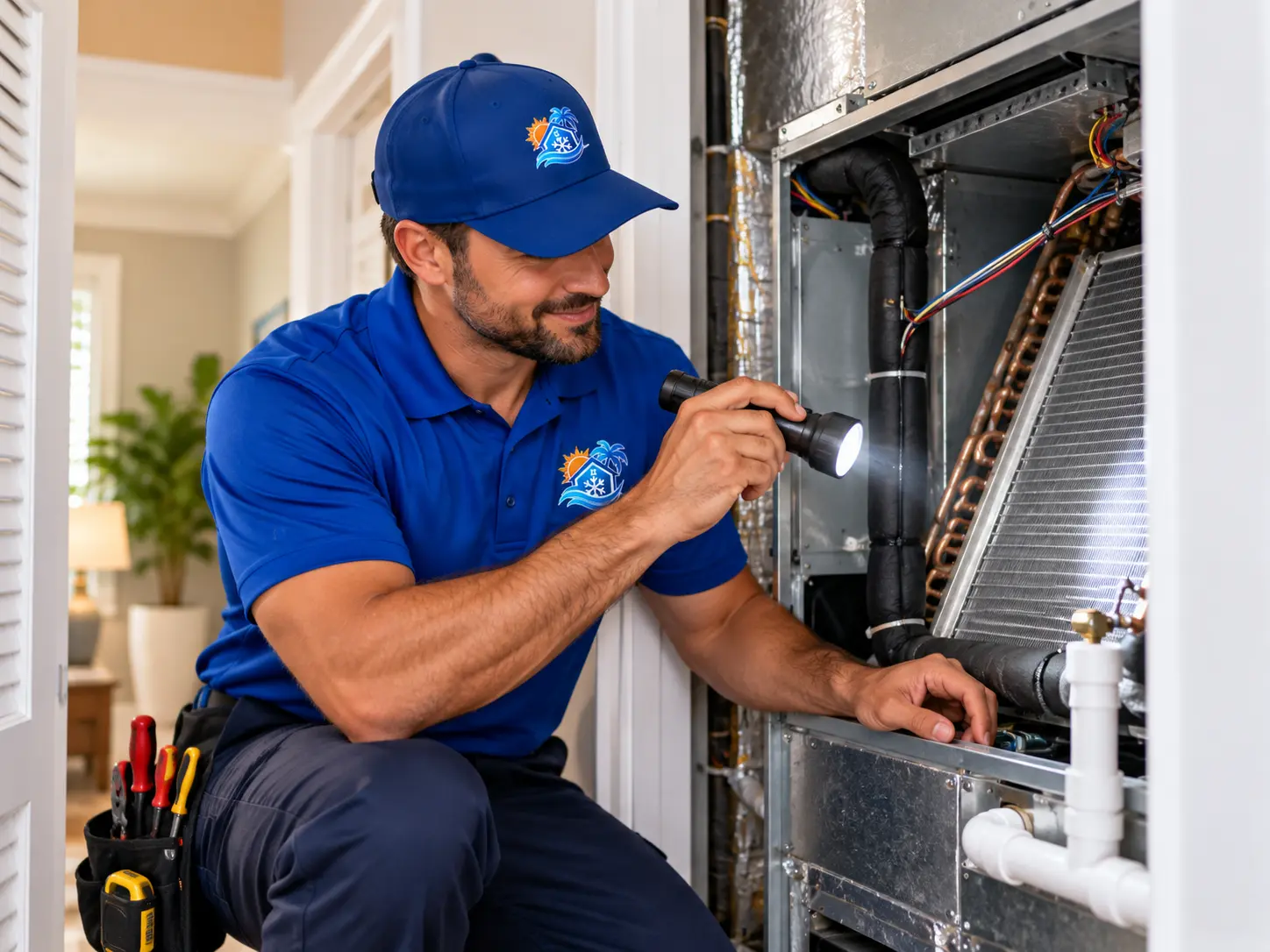
Dust that bypasses the filter sticks to the wet coil and builds a mat on the entry face. That mat does two things: it restricts airflow, and it insulates the coil surface so heat transfer drops. The result is longer run times, worse dehumidification, higher electricity use, and eventually freezing.
Filter bypass is the usual root cause — a filter that does not seal at its edges, a filter rack with gaps, or return duct leaks pulling unfiltered attic air into the system. Cleaning the coil without fixing the bypass means the fouling returns.
Evaporator coils develop pinhole leaks through formicary corrosion, a process driven by moisture combined with organic acids present in ordinary indoor air. These leaks are microscopic, so the visible evidence is usually indirect: a system that gradually loses cooling, ice on the suction line, or oily residue on the coil.
Confirming a coil leak means testing rather than assuming. Electronic detection, dye, and nitrogen pressure testing are used depending on the situation. Once confirmed, options are typically coil replacement rather than spot repair, because a coil with one corrosion leak commonly develops more.
Cleaning is the right answer for a fouled but sound coil. Depending on access and severity that ranges from cleaning in place with appropriate coil cleaner to pulling the coil for thorough cleaning, followed by clearing the pan and drain.
Replacement requires matching the coil to the outdoor unit and metering device. A mismatched coil hurts capacity and efficiency even when it physically fits. Refrigerant type also matters — on older R-22 equipment, coil replacement cost plus refrigerant often justifies comparing it against replacing the system.
For broader planning numbers, see the AC repair cost guide for Lakeland or try the repair cost calculator. Both give educational planning ranges rather than quotes.
Gradually declining cooling, weak airflow with a clean filter, repeated coil freezing, and a musty smell when the blower starts are typical indicators. Visual inspection confirms it.
Sometimes an accessible joint can be repaired, but corrosion-driven pinhole leaks usually mean the coil should be replaced, since additional leaks tend to follow.
It depends on filtration quality, indoor dust levels and run hours. Coils are inspected during routine maintenance and cleaned when fouling is present rather than on a fixed schedule.
Yes. Reduced heat transfer and restricted airflow force longer run times to achieve the same comfort, which increases consumption.
A sealed system does not consume refrigerant. If the charge is low, something is letting it out and the leak needs to be found.
Read moreIce is always a symptom of something else — airflow, charge or a control problem. Thawing alone never fixes it.
Read moreThe indoor cabinet that holds the blower, evaporator coil, drain pan and control board — and the source of many cooling faults.
Read moreHumid climates produce a lot of condensate. When the drain clogs, the system either shuts down or puts water where it should not be.
Read moreDescribe what your air conditioner is doing and we can talk through the likely causes and current availability.
211 E Main St, STE #453, Lakeland, FL 33801