Why does my AC keep freezing up?
The usual causes are restricted airflow from a dirty filter, coil or blower, or a low refrigerant charge from a leak. A metering device restriction can also freeze part of the coil.

It seems contradictory that an air conditioner would freeze in Florida heat, but it is common. Ice forms when the evaporator coil operates below freezing, and that happens whenever the coil cannot absorb enough heat — either because too little air is passing over it or because the refrigerant charge is too low.
The critical point is that ice is a symptom. Thawing the system restores airflow temporarily, but unless the underlying cause is corrected, the coil freezes again within days.
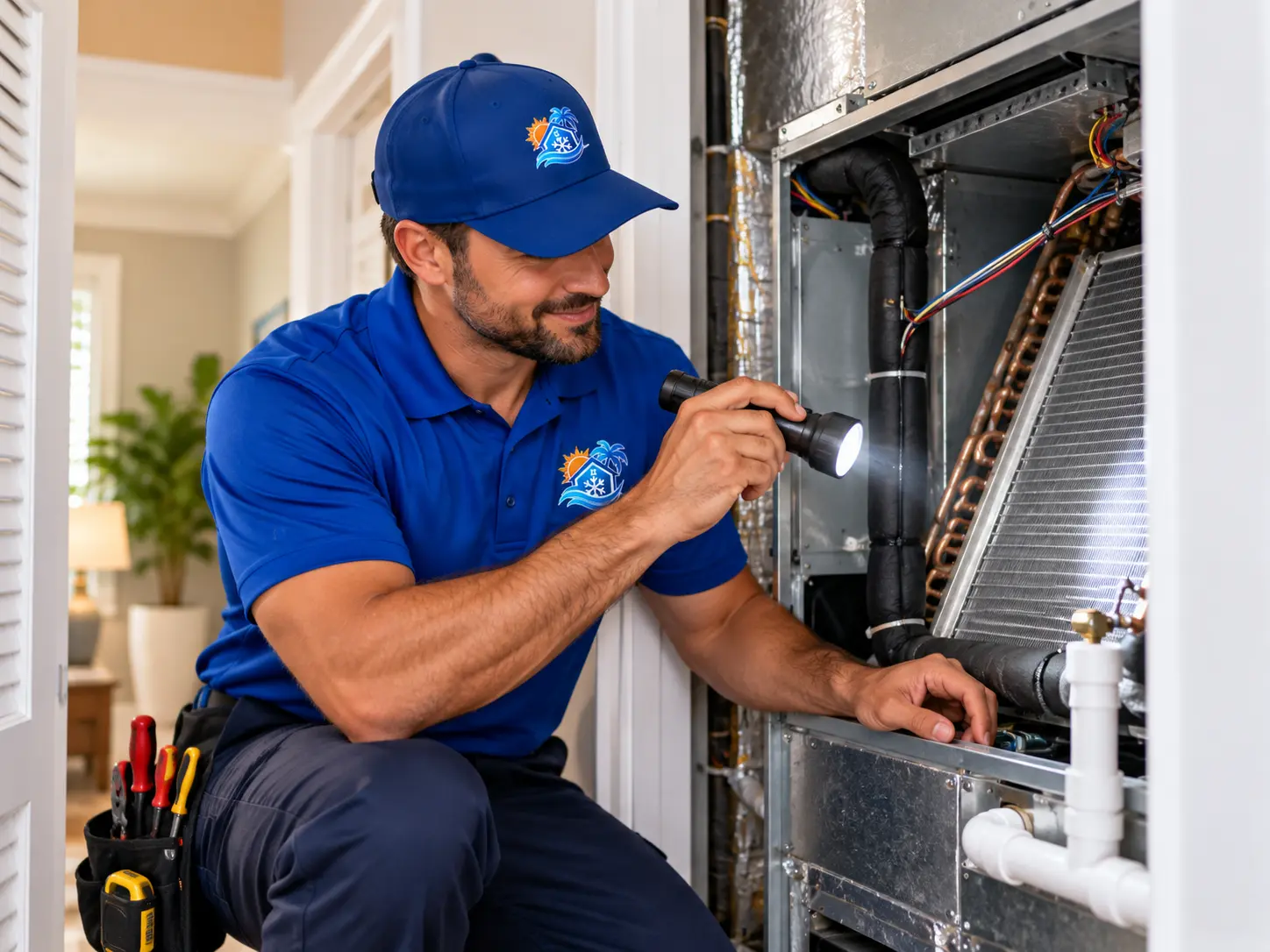
Turn the cooling off at the thermostat and set the fan to ON. Circulating room-temperature air over the coil melts the ice faster than simply switching everything off. Depending on how much ice has accumulated, this can take anywhere from an hour to most of a day.
Do not chip, scrape or pry at the ice. The coil is thin aluminum and copper, and mechanical damage from an ice pick or screwdriver turns a diagnostic visit into a coil replacement. Do not aim a heat gun at it either.
Expect water. As the ice melts, the drain pan handles more volume than usual, and a marginal drain will overflow. Keep towels handy and check for water around the air handler.
Restricted airflow is the most common cause. A loaded filter, a dirty evaporator coil, closed or blocked supply registers, crushed or disconnected flex duct, a failing blower motor, or a blower wheel caked with dust all reduce the volume of air crossing the coil.
There is a habit worth mentioning: closing vents in unused rooms. It feels efficient, but on most residential systems it reduces total airflow and can push the coil toward freezing. Leave supply registers open.
A low charge lowers the pressure and therefore the temperature inside the evaporator coil, and the surface drops below freezing. Because low charge means a leak, the fix is leak location and repair rather than a recharge.
A restricted metering device, a plugged filter drier, or a stuck expansion valve produce the same result in a localized way, often icing only part of the coil — a pattern that is diagnostically useful.
Running the system overnight when outdoor temperatures drop, setting the thermostat unusually low for extended periods, or a thermostat that never satisfies because of a sensor fault can all contribute. On systems with a variable-speed blower, an incorrect airflow setting for the installed tonnage can push a coil toward freezing under humid conditions.
Each freeze-thaw cycle risks returning liquid refrigerant to the compressor, which is not designed to compress liquid. Repeated events are a recognized path to compressor damage. If your system freezes more than once, the cause needs to be found rather than managed.
For broader planning numbers, see the AC repair cost guide for Lakeland or try the repair cost calculator. Both give educational planning ranges rather than quotes.
The usual causes are restricted airflow from a dirty filter, coil or blower, or a low refrigerant charge from a leak. A metering device restriction can also freeze part of the coil.
Typically one to several hours with the fan running. A heavily iced coil can take considerably longer.
No. Airflow is blocked, cooling is essentially zero, and continued operation risks liquid refrigerant reaching the compressor.
It can when a heavily loaded filter is the cause, but the coil still has to thaw completely first and the system should be watched to confirm it does not freeze again.
A sealed system does not consume refrigerant. If the charge is low, something is letting it out and the leak needs to be found.
Read moreThe indoor coil is where heat and humidity leave your air. Fouling, corrosion and leaks all show up as poor cooling.
Read moreThe indoor motor that moves conditioned air through your ducts. When it weakens, everything downstream suffers.
Read moreThe system runs but the house never reaches the set temperature. Start with the simple checks, then narrow down the mechanical causes.
Read moreDescribe what your air conditioner is doing and we can talk through the likely causes and current availability.
211 E Main St, STE #453, Lakeland, FL 33801