Does an air conditioner create cold air?
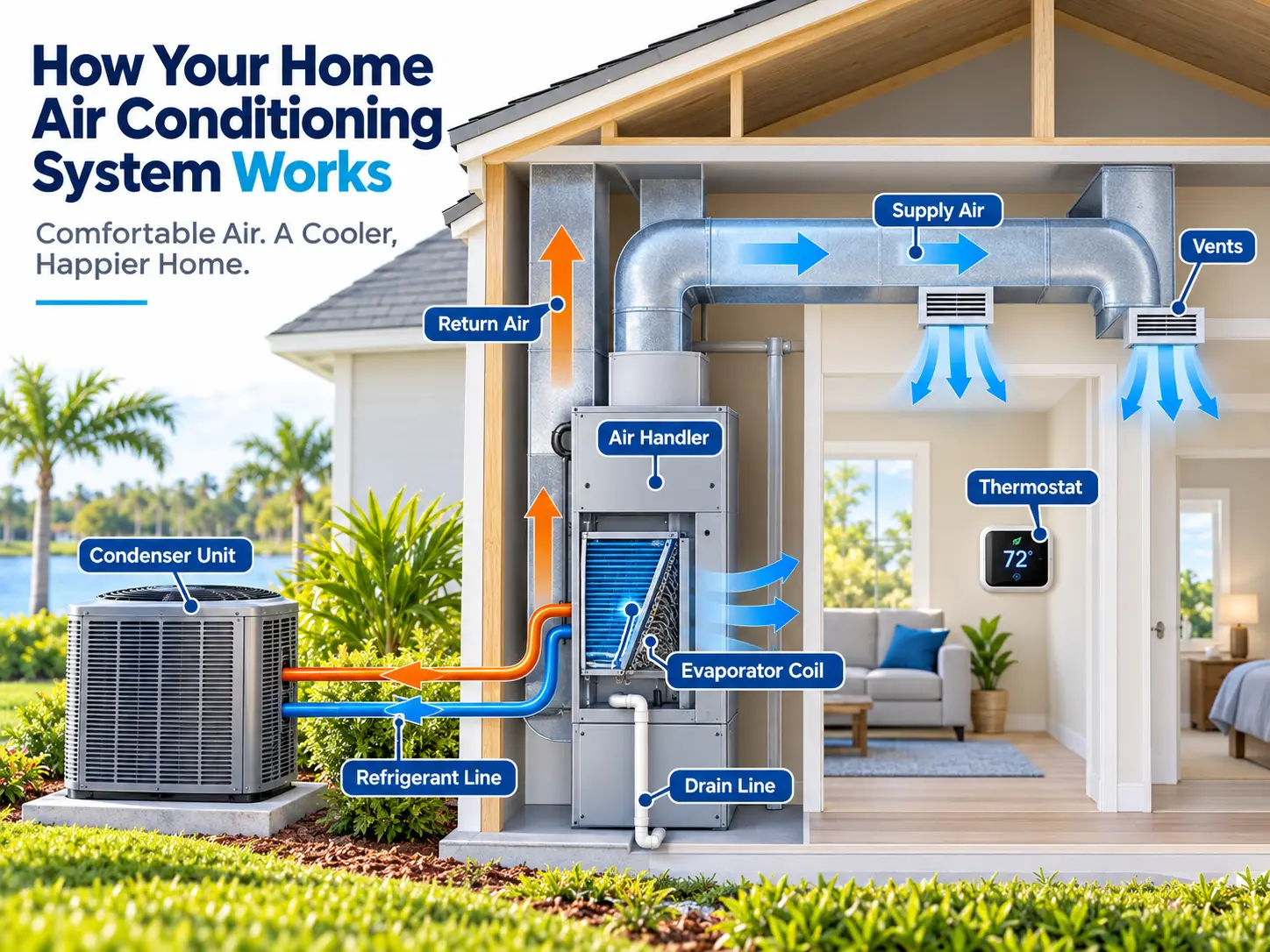
No. It moves heat. Refrigerant absorbs heat from indoor air at the evaporator coil and releases it outdoors at the condenser coil. The 'cold' you feel is simply air that has had heat removed from it.

Understanding what your system is actually doing turns a confusing breakdown into a describable problem. This guide walks through the refrigeration cycle, the components involved, and how each of them fails.
None of it requires a technical background. If you can follow water moving through a pipe, you can follow heat moving through a cooling system.
An air conditioner is a heat transport machine. It uses a refrigerant — a fluid that boils and condenses at convenient pressures — to pick up heat inside your house and release it outside. When you feel cold air at a vent, what you are actually feeling is air that has had a large amount of heat pulled out of it a few feet upstream.
Compression. The compressor takes cool, low-pressure refrigerant vapor and squeezes it into a hot, high-pressure gas. Raising the pressure raises the temperature above the outdoor air temperature, which is what makes the next step possible.
Condensing. That hot gas flows through the outdoor condenser coil while a fan pulls outside air across it. Heat leaves the refrigerant, and the vapor condenses into a warm liquid. This is why a running condenser blows hot air upward — it is exhausting the heat from your house.
Expansion. The liquid passes through a metering device — a thermal expansion valve or a fixed orifice — which drops its pressure sharply. Lowering the pressure lowers the boiling point, so the refrigerant becomes very cold.
Evaporation. The cold refrigerant enters the indoor evaporator coil. The blower pushes household air across it, heat moves from the air into the refrigerant, and the refrigerant boils back into a vapor. That vapor returns to the compressor and the cycle repeats.
Because the evaporator coil is below the dew point of the household air, moisture condenses on it and drips into the drain pan. In Central Florida this is not a side effect, it is half the comfort. It also explains why the condensate system is a frequent source of service calls here: gallons of water a day have to go somewhere, and when a drain clogs the water has nowhere to go but out.
Matching a symptom to a component is most of what a diagnosis does.
Compresses low-pressure refrigerant vapor into hot, high-pressure gas. It is the pump that drives the entire cycle and the most expensive component to replace.
Common failures: Failed windings, seized bearings, or failure caused by liquid returning from a frozen coil.
Outdoor coil where hot refrigerant releases its heat to the outside air, condensing into liquid.
Common failures: Fouling with dirt and grass clippings, bent fins, or leaks from corrosion.
Pulls outside air across the condenser coil so heat can leave the system.
Common failures: Motor burnout, failed bearings or a bad capacitor, causing high pressures and shutdowns.
A TXV or fixed orifice that drops refrigerant pressure sharply so it can absorb heat indoors.
Common failures: Sticking, blockage or an incorrectly sized replacement, causing poor cooling or freezing.
Indoor coil where cold refrigerant absorbs heat from household air and moisture condenses out.
Common failures: Formicary corrosion leaks, dirt buildup blocking heat transfer, and freezing.
Moves household air across the evaporator coil and out through the duct system.
Common failures: Motor failure, module failure on variable-speed units, and wheels caked with dust.
Protects the blower and coil from dust and keeps airflow clean.
Common failures: Loading up and restricting airflow, which is a leading cause of frozen coils.
Pan, drain line, trap, float switch and sometimes a pump, handling water pulled from the air.
Common failures: Clogs from biological growth, cracked pans, failed pumps and tripped float switches.
Contactor, capacitors, relays, control board and safety switches that start and protect the system.
Common failures: Heat-related capacitor degradation, pitted contactors and board failures.
Reads indoor temperature and calls for cooling through low-voltage wiring.
Common failures: Bad placement, dead batteries, miswiring, or a failed unit that never calls for cooling.
Insulated copper lines carrying refrigerant between the indoor and outdoor units.
Common failures: Leaks at fittings, damaged insulation causing sweating, and physical damage.
Distributes conditioned air and returns household air to the system.
Common failures: Leaks in attic runs, crushed flex duct, closed dampers and undersized returns.
Run hours are the first factor. A Lakeland system may run for most of the year, so components accumulate cycles and heat exposure far faster than the same equipment would in a cooler climate. Capacitors, contactors and motors are the first to show it.
Humidity is the second. A coil that stays wet for months supports biological growth in the pan and drain line, which is why clogs here are a year-round problem rather than an occasional one.
Attic installations are the third. Many homes place the air handler in an attic where summer temperatures are extreme, ducts leak into unconditioned space, and a condensate overflow lands on a ceiling instead of a garage floor.
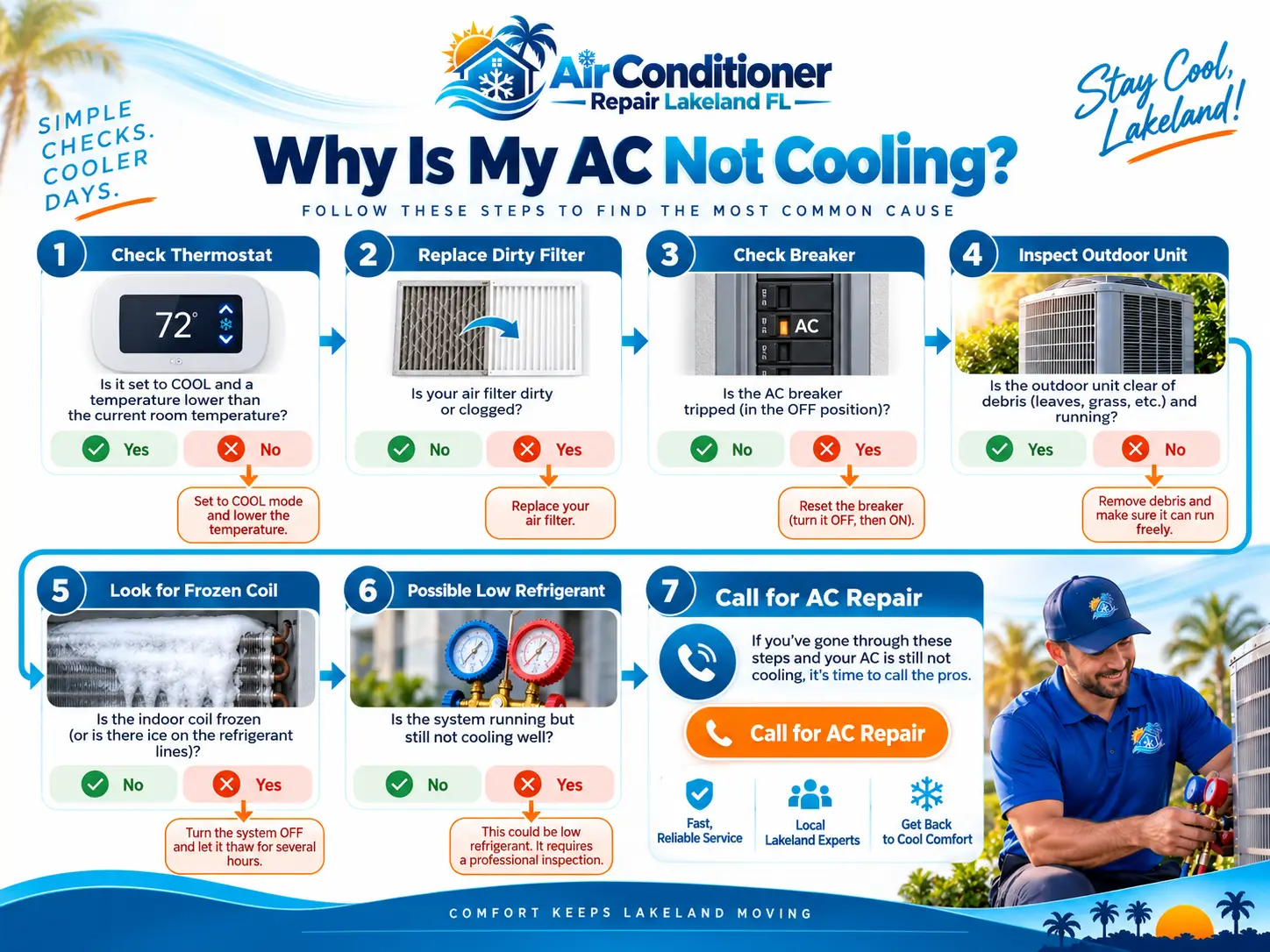
Anything past that — refrigerant, electrical testing under load, coil work — belongs with a technician, both for safety and because misdiagnosis gets expensive fast.
If your system is not cooling right now, start with AC not cooling, warm air at the vents or a frozen coil. For budgeting, see the cost guide and calculator. To keep a healthy system healthy, read about AC maintenance.
No. It moves heat. Refrigerant absorbs heat from indoor air at the evaporator coil and releases it outdoors at the condenser coil. The 'cold' you feel is simply air that has had heat removed from it.
It is the difference between the air returning to the system and the air coming out of the supply vents. A healthy residential system typically produces a meaningful drop across the coil. A small split points to a refrigerant, airflow or coil problem, and it is one of the first measurements taken during a diagnosis.
Cooling air below its dew point condenses moisture out of it. In Central Florida's humidity that is gallons per day, which is why condensate drains, pans and float switches matter as much here as the cooling components themselves.
In cooling mode a heat pump runs the same refrigeration cycle as a standard air conditioner. The difference is a reversing valve that lets it run the cycle backwards for heating, which adds one more component that can fail.
Describe what your air conditioner is doing and we can talk through the likely causes and current availability.
211 E Main St, STE #453, Lakeland, FL 33801