Why is my outside unit not running?
Common causes include a tripped breaker or disconnect, a failed capacitor, a burned contactor, a tripped safety switch, or a failed fan motor. Each is checked in sequence.

The condenser fan motor pulls outdoor air across the outdoor coil so the heat collected from inside the house can be released. In Florida's summer conditions this motor works hard, in direct sun, for very long run hours.
When it slows or stops, the refrigerant cannot reject heat properly. Discharge pressure climbs, cooling collapses, and a high-pressure safety switch usually shuts the system down — which produces the frustrating pattern of cooling that works for a while, then quits, then works again after the unit cools off.
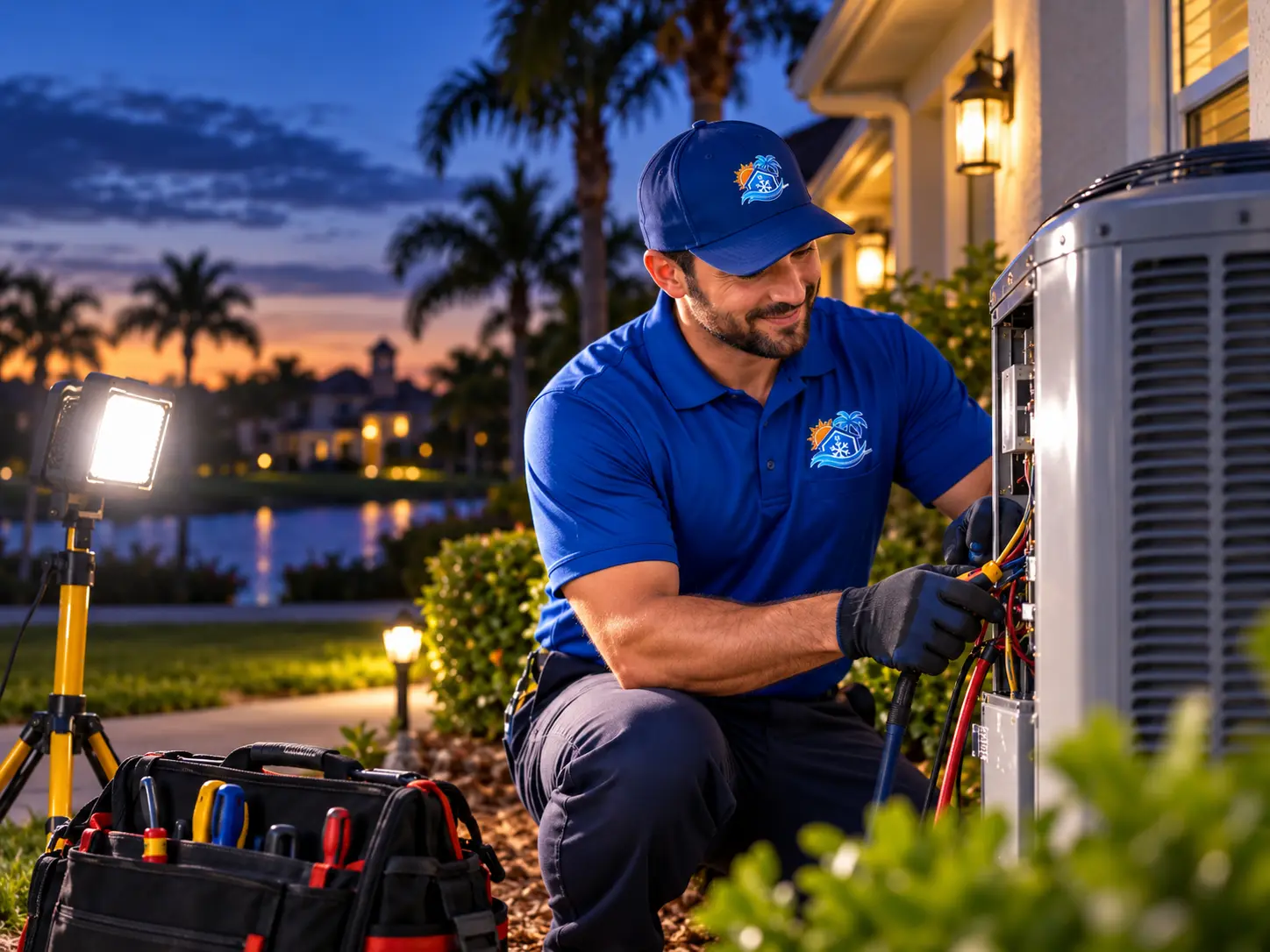
A stopped fan does not automatically mean a bad motor. The run capacitor that serves the fan is a far more common failure, and a fan that hums without starting is the textbook symptom. Testing the capacitor first avoids replacing a motor that was never faulty.
That said, a motor with worn bearings draws more current than it should and can destroy a new capacitor in short order. Amperage measurement while running tells the technician which side of that relationship is driving the failure.
Even a perfect fan motor cannot reject heat through a coil packed with grass clippings, cottonwood, pollen or dryer lint. High head pressure caused by a blocked coil overheats the motor and increases the load on the compressor.
Keeping two to three feet of clear space around the outdoor unit, keeping shrubs trimmed back, and keeping mulch and clippings away from the base is one of the most useful things a homeowner can do for equipment life.
A replacement fan motor must match horsepower, voltage, speed, rotation direction and frame size, and the blade must be reinstalled at the correct height in the shroud. Getting blade position wrong reduces airflow noticeably even when everything else is correct.
After replacement the system is run and verified: amperage, pressures, and temperature split. High-pressure trips that continue after a motor replacement usually mean the coil still needs cleaning or something else is elevating head pressure.
For broader planning numbers, see the AC repair cost guide for Lakeland or try the repair cost calculator. Both give educational planning ranges rather than quotes.
Common causes include a tripped breaker or disconnect, a failed capacitor, a burned contactor, a tripped safety switch, or a failed fan motor. Each is checked in sequence.
No. Without that airflow the system cannot reject heat, pressures climb quickly, and continued operation risks compressor damage.
That pattern usually points to a heat-related fault — a marginal capacitor, a struggling fan motor, or a dirty condenser coil causing high-pressure trips when ambient temperature peaks.
Keep the coil clear of grass, leaves and debris, keep plants trimmed back, avoid aiming irrigation at it, and have the coil cleaned during routine maintenance.
One of the most frequent air conditioning failures in Florida heat, and one of the most recognizable by symptom.
Read moreThe heart of the refrigeration circuit. Compressor problems deserve careful diagnosis before any major expense is authorized.
Read moreThe system runs but the house never reaches the set temperature. Start with the simple checks, then narrow down the mechanical causes.
Read morePreventive attention to filters, coils, drains and electrical components — the failures most worth avoiding.
Read moreDescribe what your air conditioner is doing and we can talk through the likely causes and current availability.
211 E Main St, STE #453, Lakeland, FL 33801