
Skip to content
Air Conditioner Repair Lakeland FL logo
Urgent cooling loss

Emergency AC Repair in Lakeland, FL

A cooling failure in Central Florida stops being an inconvenience quickly. Indoor temperature and humidity climb within hours, and homes with infants, older adults, pets or people who work from home feel it first. Urgent air conditioning repair is about getting an accurate diagnosis quickly, then agreeing on the repair before anything is replaced.

If your system has stopped cooling entirely, is tripping the breaker, is making a loud mechanical noise, is leaking water indoors, or has a burning smell, treat it as urgent. Call 863-270-2970 to describe the symptoms and check current availability.

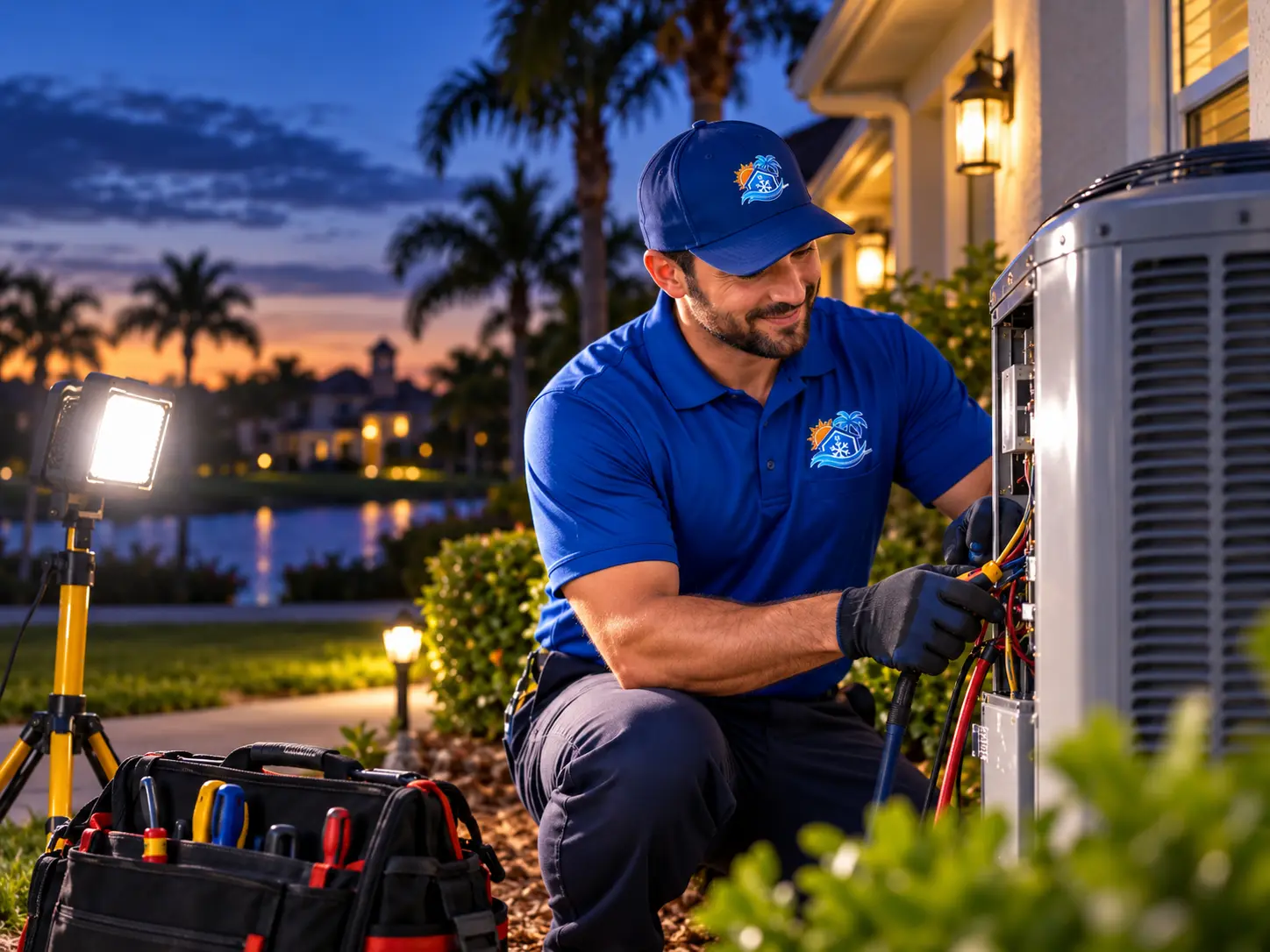
Technician working on an air conditioner condenser during an evening service visit

What counts as an air conditioning emergency

Not every cooling complaint is an emergency, and treating everything as one usually costs homeowners money. The situations below are the ones worth escalating rather than waiting on.

Escalate right away when you notice:

  • The indoor temperature is climbing steadily and the system is not producing cold air at all
  • A burning, hot-plastic or electrical smell coming from the air handler or the outdoor unit
  • Repeated breaker trips when the air conditioner starts
  • Water dripping through a ceiling, running down a wall, or pooling near the air handler
  • Loud grinding, screeching or hard-knocking sounds from the compressor or a motor
  • A household member with a medical condition that makes indoor heat genuinely unsafe

What to do before help arrives

A few safe steps protect the equipment and sometimes solve the problem outright. None of them involve opening high-voltage compartments, handling refrigerant, or bypassing a safety switch — leave all of that to a technician.

Switch the thermostat to OFF if the system is running but blowing warm air, because running a system with a refrigerant or airflow problem can turn a moderate repair into a compressor failure. Set the fan to ON for an hour if you suspect ice on the coil so the ice can thaw. Check whether the AC breaker in the panel is in a tripped or middle position, and reset it once — if it trips again, stop and leave it off.

Close blinds on sun-facing windows, run ceiling fans, and avoid the oven and dryer. None of that fixes the equipment, but it slows how fast the house heats up while you wait.

How an urgent visit is usually approached

Urgent diagnostics prioritize finding the failure point rather than guessing. Typical checks include confirming thermostat call and control voltage, verifying power at the disconnect and contactor, testing the capacitor and start components, checking the blower and airflow path, looking at the state of both coils, and reading system pressures and temperatures when the equipment can safely run.

That sequence matters because several very different faults produce the same complaint. A failed capacitor, a tripped float switch on a clogged drain, a burned contactor and a low refrigerant charge can all present as “the AC is on but nothing is cold.” The repair only gets quoted after the cause is identified, so you are approving work against a finding rather than a hunch.

After-hours and same-day considerations

Urgent scheduling depends on the day, the time and how many calls are already booked, which is why availability is confirmed by phone rather than promised on a web page. Parts availability also affects timing — common items such as capacitors, contactors and float switches are usually straightforward, while a compressor, a coil or a specific blower module can require ordering.

If a repair cannot be completed on the first visit, ask for a clear description of what was found, what the system can and cannot safely do in the meantime, and what the next step is. A system that is unsafe to run should stay off.

What affects the cost of this repair

  • Which component actually failed, and whether it is an electrical part or a sealed-system part
  • How much diagnostic time the fault takes to isolate
  • Whether the visit falls during standard hours or is scheduled urgently
  • Parts availability for the specific make and model
  • Access to the equipment, particularly attic or closet air handlers
  • Whether refrigerant work is involved and which refrigerant the system uses

For broader planning numbers, see the AC repair cost guide for Lakeland or try the repair cost calculator. Both give educational planning ranges rather than quotes.

Questions homeowners ask about this

Should I keep running the AC if it is not cooling?

Usually no. If the system runs but produces no cold air, running it can worsen the problem — a low charge or restricted airflow makes the compressor work under conditions it is not designed for. Switch the cooling call off and leave the fan available for airflow.

My breaker tripped. Can I just keep resetting it?

Reset it once. A breaker that trips again is reporting a real electrical fault such as a shorted component, a failing motor drawing too much current, or a wiring problem. Repeated resets risk damage and are unsafe.

Is an urgent visit always more expensive?

Urgent or after-hours scheduling can carry a premium compared with standard scheduling. The part and labor for the underlying repair are the larger factor in most cases.

How fast can someone get here?

That depends on the current schedule, so it is confirmed when you call rather than promised in advance. Describing the symptoms clearly helps with prioritizing and with bringing likely parts.

Need help with emergency ac repair in Lakeland?

Describe what your air conditioner is doing and we can talk through the likely causes and current availability.

211 E Main St, STE #453, Lakeland, FL 33801

Call NowRequest Service