Why is my air handler leaking water?
Most often a clogged condensate drain overflowing the pan. A corroded pan, a disconnected drain line, a frozen coil that has thawed, or a very dirty coil can also cause it.

The air handler is the indoor half of a split system. Inside one cabinet you have the blower assembly, the evaporator coil, the drain pan, the filter rack, the control board, the transformer and often electric heat strips. Problems in any of those show up as cooling complaints.
Because attic and closet installations are common in Florida homes, air handler issues also carry a water-damage dimension that outdoor equipment does not.
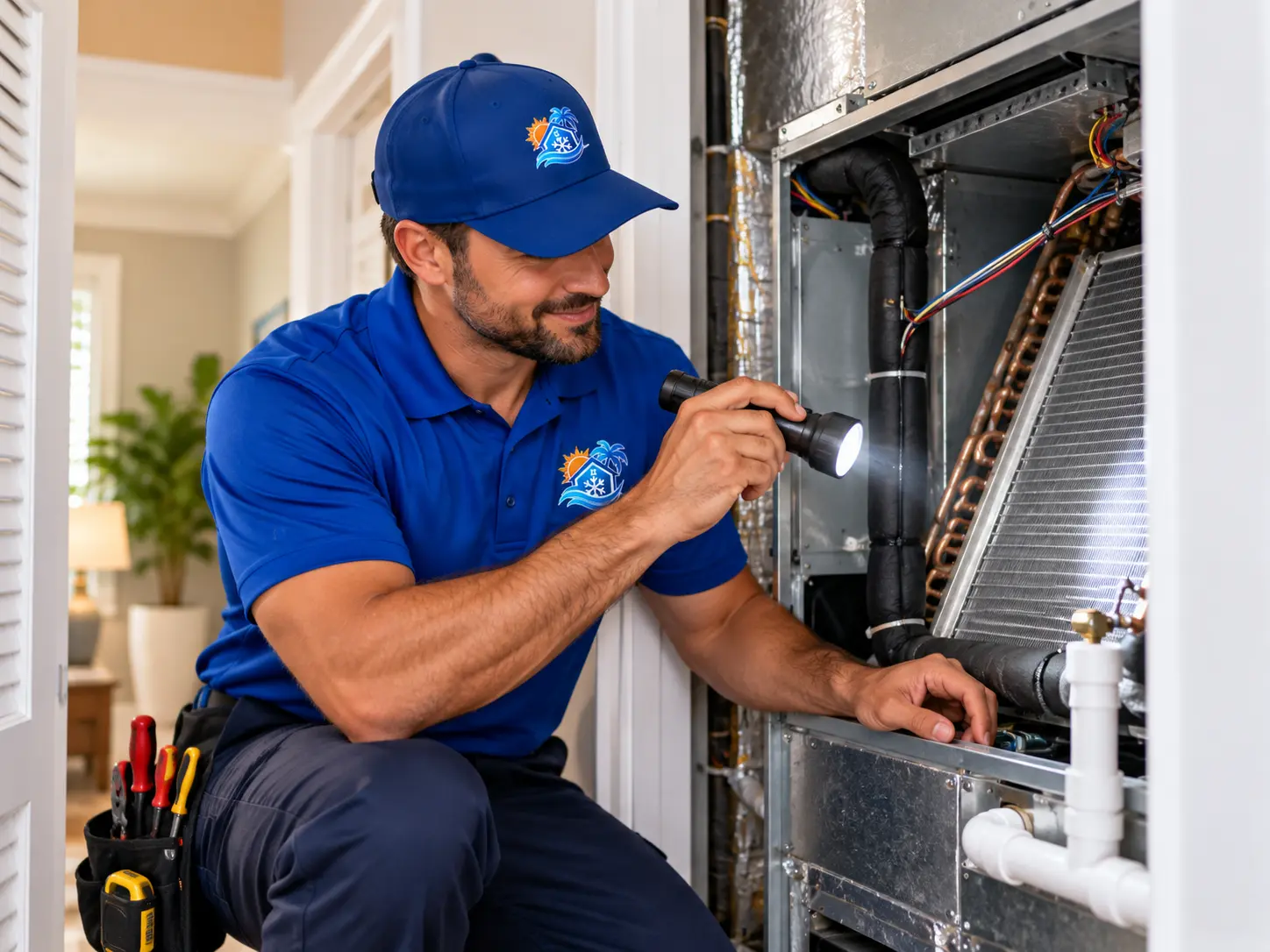
When nothing runs indoors, the sequence is straightforward: confirm the indoor breaker and the service switch, check the low-voltage transformer output, check the board fuse, verify the thermostat call is reaching the board, and check safety devices in the circuit — the float switch being the most common interruption.
That last item catches a large share of these calls. A system that appears electrically dead is often a system protecting itself from a clogged drain.
Condensate has to be captured by the pan and carried away. Common failures include a blocked primary drain, a corroded pan, a disconnected or improperly sloped drain line, or a coil so dirty that water is pushed off the fins and past the pan by air velocity.
For attic installations, verifying that the secondary pan and its overflow protection are intact is part of a proper repair. Those components exist specifically to keep a drainage issue from becoming a ceiling replacement.
Supply and return connections at the air handler are a frequent source of losses. A return that leaks in an attic pulls in hot, dusty, humid air, degrading capacity and fouling the coil. A supply plenum leak sends the air you paid to cool into the attic.
Sealing those connections properly often improves comfort more noticeably than any component replacement, particularly in homes where certain rooms never keep up.
Individual components — motors, boards, transformers, pans, float switches — are replaceable. Replacement of the whole air handler becomes the conversation when the coil is leaking, the cabinet is corroded, and the equipment is old enough that indoor and outdoor units are no longer a good match. Those factors get laid out plainly so the choice stays yours.
For broader planning numbers, see the AC repair cost guide for Lakeland or try the repair cost calculator. Both give educational planning ranges rather than quotes.
Most often a clogged condensate drain overflowing the pan. A corroded pan, a disconnected drain line, a frozen coil that has thawed, or a very dirty coil can also cause it.
Check the indoor breaker and service switch first. Beyond that, a tripped float switch, a blown control fuse, a failed transformer, or a control board fault are typical causes.
Yes. Filter changes, drain and pan checks, coil inspection, blower wheel condition and electrical connections are all part of routine service on the indoor unit.
Sometimes, but indoor and outdoor components need to be matched for capacity, metering and refrigerant. A mismatch reduces efficiency and can shorten equipment life.
The indoor motor that moves conditioned air through your ducts. When it weakens, everything downstream suffers.
Read moreHumid climates produce a lot of condensate. When the drain clogs, the system either shuts down or puts water where it should not be.
Read moreThe indoor coil is where heat and humidity leave your air. Fouling, corrosion and leaks all show up as poor cooling.
Read moreWhole-home ducted systems: outdoor condenser, indoor air handler, duct network and controls working as one.
Read moreDescribe what your air conditioner is doing and we can talk through the likely causes and current availability.
211 E Main St, STE #453, Lakeland, FL 33801